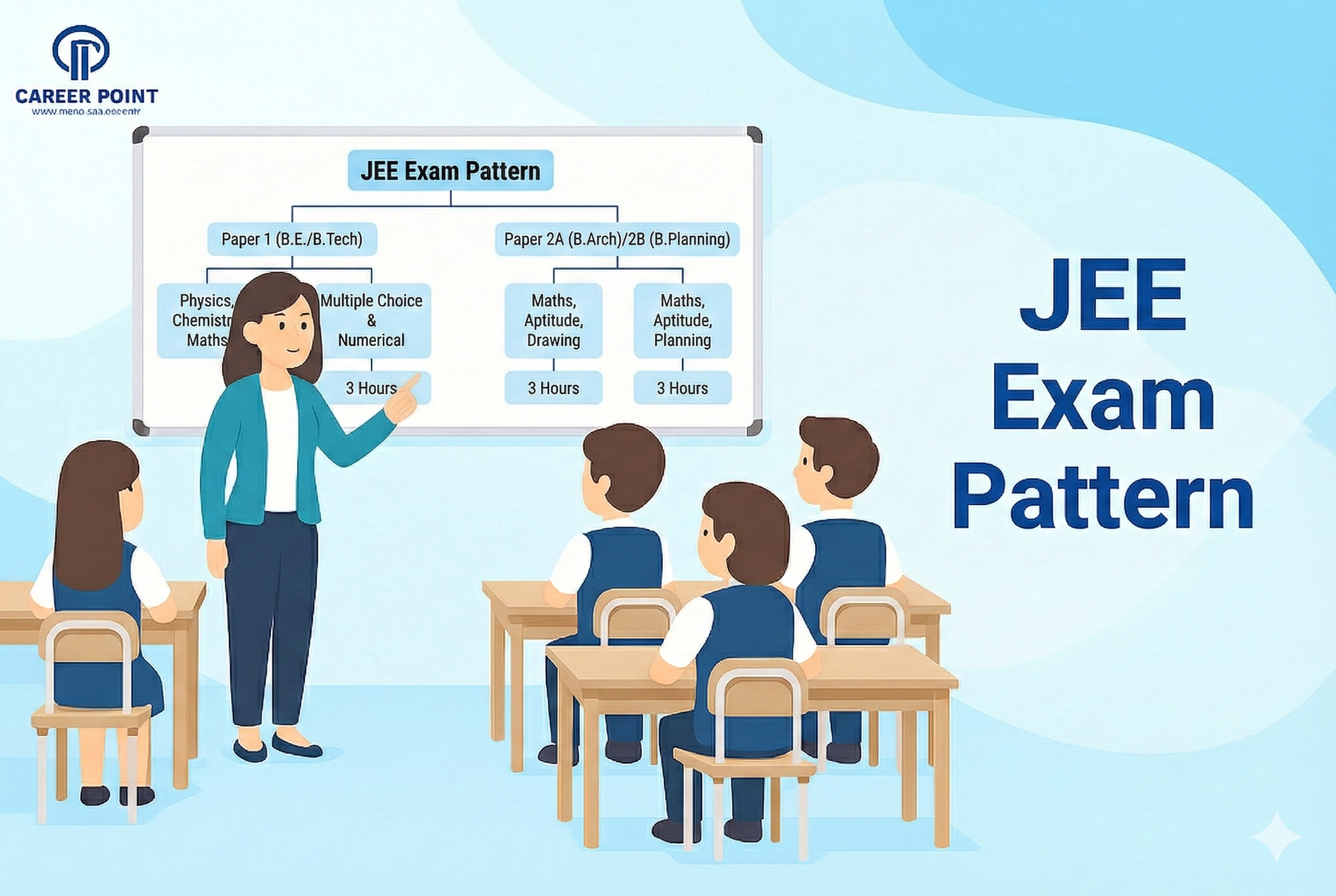
JEE Exam Pattern
Cracking JEE starts with one simple thing: knowing the exam pattern inside out. It's not just about what subjects to study---it's about understanding how the questions come, how marks get awarded, and how to outsmart the time crunch. Whether you're aiming for IITs through Advanced or securing a spot in NITs via Main, this pattern is your secret weapon for scoring big.
What Exactly is JEE and Why Pattern Matters
Picture this: JEE, or Joint Entrance Examination, is India's toughest engineering entrance test. It's your ticket to top colleges like the 23 IITs, 31 NITs, IIITs, and hundreds of other great institutes. Run by NTA for JEE Main and IITs for Advanced, it splits into two levels---Main qualifies you for 80% of engineering seats and Advanced for the IIT dream.
Why obsess over the pattern? Because it tells you exactly what to expect: 75 questions in Main Paper 1, negative marking that punishes guesses, and numerical problems that test real calculation skills. Get this wrong, and even perfect prep goes to waste. Sessions happen twice a year---January and April---so you've got two shots at your best score. No age limit, but just six attempts over three years. Smart aspirants use the pattern to build a study plan that mirrors exam day.
JEE Main Paper 1: The Engineering Core
Let's dive deep into Paper 1 for B.E./B.Tech---the heart of JEE for most students. Total 75 questions: 25 each from Physics, Chemistry, and Math. Broken into Section A (20 MCQs per subject---pick one right answer) and Section B (5 numericals per subject, all must-do now).
Three hours flat, 300 marks total. Physics? Think mechanics (laws of motion, work-energy), electromagnetism (circuits, fields), waves, thermo. Chemistry splits into physical (equilibrium, kinetics), inorganic (p-block, metallurgy), organic (named reactions, stereochemistry). Math is calculus heaven---differentiation, integration, limits---plus algebra, vectors, 3D geometry.
Real talk: 60% questions are straightforward if you've nailed NCERT, 30% twist concepts, 10% are rank-deciders. Marking is brutal: +4 for right, -1 for wrong on everything, zero if skipped. That means one wrong guess costs you big---aim for accuracy over quantity.
Cracking the Marking Scheme Like a Pro
Negative marking isn't a joke. Say you attempt 60 questions but get 10 wrong: that's -10 dragging down your +240 from corrects. Toppers hit 250-280 by nailing 55-60 attempts at 90% accuracy. Percentiles rule ranks due to normalization---your 250 in a tough shift might rank higher than 260 in an easy one.
Pro tip: Start with your strongest subject. Physics numericals? Punch in exact values (like 9.8 or 2.5, no units). On-screen calculator is basic---practice mental math. Unattempted is safe, but leaving Section B blanks? Rookie mistake, that's 60 easy marks gone.
Paper 2A: B.Arch -- Where Creativity Meets Math
Not everyone wants pure engineering. B.Arch aspirants tackle Paper 2A: 30 Math questions, 50 Aptitude, 2 Drawing tasks. 400 marks, 3 hours. Math and Aptitude are computer-based; drawing's old-school pen-paper.
Aptitude tests visualization---imagine cubes unfolding, count shadows, spot patterns. Drawing? Sketch a bedroom from memory or convert 2D to 3D. 100 marks here reward bold lines, proportions, not Picasso-level art. Marking same: +4/-1. Daily 30-min sketches build speed---focus on perspective, scale, neatness.
Paper 2B: B.Planning -- Urban Minds Unite
B.Planning (Paper 2B) mirrors 2A but swaps drawing for 25 Planning questions. Math (30), Aptitude (50), Planning (town maps, pollution graphs, smart city concepts). All online, 400 marks.
This suits folks into civil/urban design. Questions like "identify zoning from aerial view" test GK + logic. Prep with atlas, current affairs (Smart Cities Mission), aptitude books. Same marking---precision wins.
JEE Advanced: When Main Feels Like Warm-Up
Clear top 2.5 lakh in Main? Welcome to Advanced---two 3-hour papers, 54-ish questions total. No fixed pattern; changes yearly. Mix of single/multiple correct MCQs, numericals, match-the-following, paragraph questions.
Marks around 360, with partial scoring (+3 full, +1 partial, negatives vary). Physics goes quantum deep, Chem hits advanced organics, Math crushes functionals. It's 70% application, 30% tricks. Only 10k seats, so cutoffs sky-high (180+ for general).
Time Management Hacks Based on Pattern
Three hours = 2.4 mins per question in Paper 1. Strategy: 45 mins per subject first pass (easy ones), 30 mins numericals, last 15 for toughies. Practice 100 full mocks---NTA site has free ones.
Section B numericals? Solve approximations first. In Advanced, read all questions per section before starting---some give options to eliminate.
Subject-Wise Weightage and Syllabus Secrets
From patterns over years:
- Physics: Mechanics 25%, Electro 20%, Modern 15%.
- Chemistry: Organic 35%, Physical 30%, Inorganic 35%.
- Math: Calculus 30%, Algebra 25%, Coordinate 20%.
NCERT is 90% bible---read line-by-line. Beyond: HC Verma Physics, OP Tandon Chem, Cengage Math. PYQs (last 10 years) repeat twists 20-30%.
Common Traps and How to Dodge Them
Trap 1: Over-attempting---leads to -20 score drop. Trap 2: Ignoring numericals---free 60 marks. Trap 3: Weak revision---no formula sheet? Panic. Trap 4: No mocks---CBT feels alien on day.
Health hack: 7-8 hours sleep, 30-min walks. Exam day: Light breakfast, reach 1 hour early.
Month-by-Month Prep Roadmap
Months 1-4: Foundation
- NCERT mastery. 50 MCQs + 20 numericals daily/subject.
Months 5-8: Intensive
- Topic-wise tests. 3 mocks/week, error log. Fix weaknesses (say, rotations in Math).
Months 9-12: Peak
- 2 mocks/day. Formula flashcards. Analyze: Why wrong? Concept gap or calculation?
Target: From 150 to 250+ in mocks. Join test series (FIITJEE, Allen) for competition feel.
Tech Tools and Resources
NTA app for mocks. YouTube: Unacademy, Physics Wallah for pattern breakdowns. Books: Arihant PYQs, MTG 35 Years. Track progress in Excel---attempts vs scores.
For Advanced: RESONANCE papers, black book formulas.
Real Topper Stories Tied to Pattern
Rohit (AIR 52, 2024) skipped 15% doubts, hit 285. Priya (NIT Trichy) mastered numericals late, jumped 100 marks. Pattern awareness = their edge.
Final Push: Exam Day Blueprint
Morning shift? Sleep by 10 PM. Carry admit card, ID, black pens. First 10 mins: Scan paper. End with revision. Post-exam: Don't discuss---chill.
JEE pattern isn't static---check nta.ac.in yearly. But core stays: Accuracy > Speed > Coverage.
Master this, and you're not just prepared---you're unstoppable. NIT/IIT awaits. Grind smart, not hard.