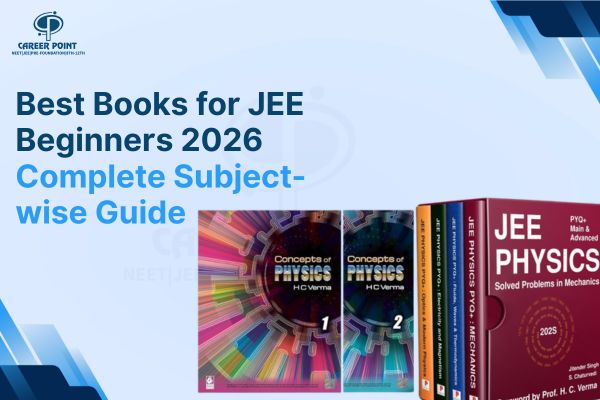
Best Books for JEE Beginners (Complete Guide 2026)
At first, the JEE preparation process may seem intimidating. Students don't know where to begin, most books on JEE preparation seem to offer the same information, and the options for resources seem endless.
The reality is you don't need countless books to succeed in JEE. Instead, you need the right mix of conceptual material and practice material.
This guide provides information on JEE foundation books for complete beginner preparation — subject-wise, with clear reasoning for each recommendation.
Why Choosing the Right Books Matters
Selecting the right books at the beginning can make or break your JEE preparation journey. The right books will:
- Build solid foundations within your conceptual understanding
- Improve your problem-solving skills step by step
- Keep you consistent and motivated throughout preparation
- Save time and clear confusion early on
The wrong and excessive books, on the other hand, can lead to confusion, information overload, and wasted preparation time.
1. Concepts of Physics by H.C. Verma
This book is highly recommended to all JEE preparation students and is considered an essential starting point for Physics.
Why This Book Works:
- Written in simple, clear English that beginners can follow
- Treats fundamentals with exceptional depth and quality
- Gradually increases question difficulty — perfect for building confidence
👉 Ideal For:
- Teaching fundamentals for Class 11 and 12 Physics
- Students starting JEE preparation from scratch
2. NCERT Physics (Class 11 & 12)
A book that is typically underrated but is absolutely essential for JEE preparation.
Why This Book Works:
- Lays out basic theories clearly and precisely
- Covers all the fundamentals directly tested in JEE Main
- Provides the base needed before attempting advanced reference books
👉 Ideal For:
- Building a clear conceptual base before moving to H.C. Verma exercises
Chemistry is unique because it is divided into 3 parts — Physical, Organic, and Inorganic — and each requires a different approach.
1. NCERT Chemistry (Essential — Class 11 & 12)
For Chemistry, NCERT is not just recommended — it is non-negotiable. JEE questions directly test NCERT Chemistry content.
Why This Book Works:
- Excellent for Inorganic Chemistry — most questions come directly from it
- Forms the base for all three branches of Chemistry
- JEE questions frequently reference NCERT content word for word
👉 Ideal For:
- All JEE beginners — must be read cover to cover before any other book
2. MTG NCERT at Your Fingertips
A companion workbook built entirely around NCERT — perfect for consolidating what you've already read.
Why This Book Works:
- Chapter-wise MCQs that test NCERT understanding directly
- Entirely based around NCERT — no unnecessary extra content
- Great for quick revision before tests and mock exams
👉 Ideal For:
- Revision and MCQ practice after completing NCERT Chemistry
1. Cengage Mathematics Series
One of the most comprehensive and highly recommended Mathematics resources for JEE beginners and advanced students alike.
Why This Book Works:
- Theories and examples are very descriptive and easy to follow
- Uses a systematic, step-by-step approach to problem-solving
- Covers the full spectrum — from basic concepts to advanced JEE-level problems
👉 Ideal For:
- Students who want a single comprehensive Mathematics resource
- Building problem-solving skills progressively
2. NCERT Mathematics (Class 11 & 12)
Just like in Physics and Chemistry, NCERT Mathematics forms the essential foundation before moving to advanced books.
Why This Book Works:
- Lays the foundation of all mathematical fundamentals tested in JEE Main
- Simple to follow with well-structured exercises
- Ensures no gaps in basic concepts before tackling Cengage
👉 Ideal For:
- Starting Mathematics preparation — complete before Cengage
Best Practice Book — Highly Recommended for All Subjects
Previous Year Questions (PYQs)
Practising PYQs is one of the smartest moves any JEE aspirant can make — regardless of the stage of preparation.
Why PYQs Are Essential:
- Helps you understand the style and layout of actual JEE exams
- Identifies key areas that consistently appear in the exam
- Builds speed and accuracy under real exam conditions
- Shows the evolution of question difficulty over the years
👉 Recommendation:
- Attempt at least the last 10 to 15 years of JEE questions for each subject
Subject-wise Book Summary
| Subject | Book | Best For |
|---|---|---|
| Physics | NCERT Physics | Conceptual foundation |
| Physics | Concepts of Physics — H.C. Verma | Fundamentals + practice problems |
| Chemistry | NCERT Chemistry | Inorganic + base for all branches |
| Chemistry | MTG NCERT at Your Fingertips | MCQ practice + quick revision |
| Mathematics | NCERT Mathematics | Fundamental concepts |
| Mathematics | Cengage Mathematics Series | Comprehensive problem-solving |
| All Subjects | Previous Year Questions (PYQs) | Speed, accuracy & exam familiarity |
Common Mistakes Beginners Make
Many students make avoidable mistakes when selecting and using study material. Watch out for these:
- ❌ Using too many books — leads to confusion and incomplete preparation
- ❌ Ignoring NCERT — the most common and costly mistake for JEE beginners
- ❌ Rushing to advanced books — before fundamentals are solid
- ❌ Not revising — reading once without revision is not enough
Avoiding these mistakes alone will significantly boost your preparation.
Smart Strategy to Use These Books
The Right Order of Preparation
This method is far more effective than studying randomly or jumping between books:
Step-by-Step Approach:
- Step 1: Begin with NCERT for all three subjects to build concept clarity
- Step 2: Select one reference book per subject (H.C. Verma / Cengage / MTG)
- Step 3: Practise questions daily — consistency matters more than volume
- Step 4: Follow regular revision cycles — don't let topics go cold
- Step 5: Solve PYQs topic-wise as you complete each chapter
Key Principle:
- Quality over quantity — one book done thoroughly beats five books done partially
Additional Tips for JEE Beginners
Study Habits
What to Do:
- Stay patient, committed, and disciplined every day
- Limit your resources — fewer books, more depth
- Make concise notes for quick revision
- Be consistent — small daily progress compounds over time
Error Management
What to Do:
- Practise questions regularly from the start
- Analyse every mistake — don't just move on
- Maintain an error log to track repeated mistakes
- Review weak areas before your next practice session
In Closing
Having the right books in your JEE preparation can set the tone for the long, hard road ahead. JEE is a game of building a solid foundation of basic fundamentals, followed by the acquisition of more advanced problem-solving techniques.
Remember — the right resources combined with consistency will always outperform sheer volume of material.
- Start with NCERT and build upward
- Be smart in your selection of reference books
- Stay dedicated, and trust the process